You Won’t Believe What Kota Kinabalu’s Buildings Hide
Kota Kinabalu isn’t just about sunsets over the South China Sea or hikes up Mount Kinabalu. Hidden in plain sight is a world of architecture that tells the story of cultures colliding and coexisting—colonial facades, Islamic domes, Chinese shophouses, and modern green designs. I walked its streets, camera in hand, stunned by how much history lives in the brick and mortar. This city’s soul? It’s written in its structures. From the echoes of British rule to the resilience of indigenous design, every building carries a legacy shaped by climate, conflict, and community. To walk through Kota Kinabalu is not merely to pass through a city, but to journey through time, one façade at a time.
First Impressions: The Urban Fabric of KK
Kota Kinabalu, often affectionately called KK, presents a skyline that defies expectations. Unlike the dense forest of skyscrapers seen in Kuala Lumpur or Singapore, KK maintains a human-scale charm. Its cityscape is defined by low-rise buildings, wide boulevards, and an openness that allows sea breezes to flow freely. This is no accident. The city’s architectural character has been shaped as much by its tropical climate as by its complex history. Buildings are designed with ventilation in mind—high ceilings, cross-ventilation windows, and shaded walkways known as five-foot ways protect pedestrians from both sun and sudden downpours. These thoughtful adaptations make the urban experience not only bearable but pleasant, even in the humidity of midday.
The city’s layout also reflects a series of rebirths. In 1897, a devastating fire swept through the original settlement, reducing much of the wooden town to ashes. This tragedy prompted a reconstruction effort that introduced more durable materials like brick and stone. Later, during World War II, Kota Kinabalu was heavily bombed, particularly its waterfront area. These events, though tragic, created a blank slate that allowed for deliberate urban planning in the postwar years. The result is a city that, while modern in parts, retains a sense of continuity with its past. Newer developments rise alongside heritage buildings, creating a layered visual narrative that rewards close observation.
What stands out most is how geography influences design. Nestled between the South China Sea and the Crocker Range, KK’s buildings often orient themselves to capture views and breezes. Rooftops slope gently to handle heavy rainfall, and open-air designs dominate public spaces. Even today’s modern hotels and shopping centers incorporate large overhangs, natural lighting, and open courtyards—features that echo traditional wisdom. This blend of old and new isn’t just aesthetic; it’s a practical response to living in a hot, wet, and beautiful corner of the world. The city doesn’t fight nature—it collaborates with it, and that partnership is visible in every well-placed window and shaded arcade.
Colonial Echoes: British-Era Structures That Still Stand
Walking through the heart of Kota Kinabalu, one cannot miss the remnants of British colonial rule. Though the era was brief—from the late 19th century until the Japanese occupation in 1942—its architectural footprint remains. The most prominent survivor is the Old Courthouse, a symmetrical two-story building with arched windows, a central clock tower, and wide verandas that wrap around its perimeter. Constructed in the 1890s, it once served as the administrative center of North Borneo. Today, it houses cultural exhibits and art galleries, but its presence is more than decorative—it is a testament to a time when European governance met tropical reality.
What makes colonial architecture in KK distinct is its adaptation to the local environment. Unlike the heavy stone buildings of Britain, these structures were built for heat and humidity. They feature timber louvred windows that allow airflow while providing shade, high ceilings to let hot air rise, and pitched roofs covered in corrugated iron to shed rain quickly. The wide verandas, supported by thick brick columns, create shaded zones perfect for social gatherings or escaping the midday sun. These were not mere copies of British design; they were thoughtful reinterpretations, born of necessity and ingenuity.
Another iconic structure is the Atkinson Clock Tower, perched on a hill overlooking the city. Built in 1905 in memory of Francis Atkinson, a young British educator, it is one of the oldest standing buildings in KK. Its simple elegance—a white tower with arched openings and a pyramidal roof—belies its resilience. It survived the 1897 fire and the WWII bombings, standing as a silent witness to the city’s evolution. Locals say the chimes once helped fishermen time their return to shore. Whether true or not, the story speaks to how deeply these buildings are woven into daily life.
These colonial structures endure not just because of their solid construction, but because they have been repurposed with care. The Old Courthouse is no longer a seat of justice, but a cultural hub. The Land and Survey Department building, another colonial relic, still functions in its original role, blending heritage with utility. This continuity gives Kota Kinabalu a rare quality—its history isn’t locked in museums; it’s lived in, worked in, and walked past every day. The colonial past is not glorified, but acknowledged, preserved as part of a larger story.
Cultural Layers: Chinese Shophouses and Their Stories
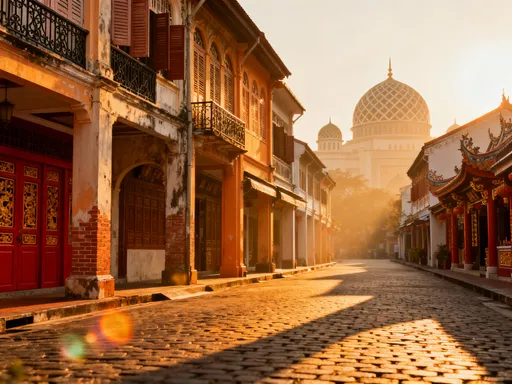
Along Gaya Street, the oldest commercial road in Kota Kinabalu, rows of narrow two-story buildings line the pavement. These are Chinese shophouses, built primarily by Hakka and Cantonese merchants in the late 19th and early 20th centuries. With their colorful facades, intricate plasterwork, and recessed entrances, they form one of the city’s most distinctive architectural features. Each shophouse follows a classic formula: a narrow frontage, a deep interior, and an air well or courtyard that brings light and ventilation into the upper floor. This design was not just practical—it reflected the values of the community: efficiency, resilience, and a balance between public and private life.
The ground floors were always reserved for business—dry goods, textiles, herbal medicine, or food stalls—while the upper floors served as family homes. This vertical separation allowed for a seamless blend of commerce and domesticity. Families lived above their livelihoods, creating a rhythm of life where work and rest flowed together. The five-foot way, a covered walkway in front of each shop, was more than a shelter from rain; it was a social space where neighbors greeted one another, children played, and news was exchanged. In this way, the shophouses were not just buildings—they were the fabric of community life.
Many of these shophouses feature decorative elements that hint at their owners’ origins. Carved wooden panels, ceramic tiles from southern China, and ornate plaster motifs with floral or symbolic patterns still survive, though some are faded by time and weather. Restoration efforts have helped preserve key sections of Gaya Street, especially around the Sunday market area, where heritage and commerce continue to coexist. However, not all shophouses have been so lucky. Some have been abandoned, their roofs sagging, their walls cracked. Others have been replaced by modern shops with little regard for historical continuity.
Preservation in this area is a delicate balance. While tourism brings attention and funding, it also brings pressure to modernize. The challenge lies in maintaining authenticity without freezing the neighborhood in time. Some restored shophouses now house cafes, craft shops, and boutique hotels, blending old charm with new function. This adaptive reuse is key to ensuring these buildings remain relevant. They are not relics behind glass—they are living spaces, evolving with the city. For visitors, walking through Gaya Street is like flipping through the pages of a family album, where each building tells a story of migration, ambition, and belonging.
Islamic Architecture: Domes, Minarets, and Quiet Grandeur
One of Kota Kinabalu’s most striking landmarks is the Sabah State Mosque, its gleaming white domes rising gracefully above the waterfront. Often photographed at sunset, when its reflection dances on the water, the mosque is more than a place of worship—it is a symbol of harmony between faith, nature, and design. Completed in 1970, it blends Mughal, Malay, and modern Islamic architectural styles. Its most distinctive feature is the large onion-shaped dome, flanked by four smaller domes and a slender minaret that reaches toward the sky. The entire complex is set within a landscaped garden, complete with fountains and reflective pools that enhance its serene atmosphere.
The design of the mosque is deeply intentional. The use of arched iwans—vaulted portals—invites visitors into a space of quiet contemplation. Geometric patterns, a hallmark of Islamic art, adorn the walls and floors, symbolizing the infinite nature of creation. The interior is spacious and light-filled, with high ceilings and large windows that allow natural ventilation. These features are not just beautiful—they serve a spiritual purpose. In Islamic tradition, architecture should reflect divine order, balance, and purity. The mosque’s symmetry, clean lines, and use of water all contribute to a sense of peace and unity with the surrounding environment.
What makes the Sabah State Mosque particularly special is its integration with the landscape. Unlike mosques built in crowded urban centers, this one breathes. It is surrounded by open space, allowing sea breezes to flow through its courtyards. The reflective pools not only enhance beauty but also cool the air through evaporation. This connection to nature reinforces the Islamic principle of stewardship over the Earth. Visitors, whether Muslim or not, often remark on the calm they feel upon entering—proof that good architecture can transcend religion and speak to the human spirit.
The mosque is also a gathering place for the community, especially during Friday prayers and religious festivals. Its large prayer hall can accommodate thousands, and the surrounding grounds are often used for educational events and cultural programs. In this way, the building fulfills both spiritual and social roles. It stands as a reminder that architecture, at its best, serves people—not just in function, but in meaning. For many residents, the silhouette of the domes against the evening sky is not just a view; it is a part of home.
Indigenous Influences: Where Tradition Meets Modern Design
Beyond the colonial, Chinese, and Islamic layers of Kota Kinabalu’s architecture lies a deeper, older foundation: the built traditions of the Kadazan-Dusun people, the largest indigenous group in Sabah. Their influence is subtle but significant, visible in the use of natural materials, organic forms, and symbolic motifs. Traditional Kadazan-Dusun homes, known as longhouses or banuas, were built on stilts, with thatched sugud roofs made from sago palm leaves. These designs were not arbitrary—they responded to the rainforest environment, providing protection from floods, pests, and heat.
Today, elements of this vernacular architecture are being revived in modern projects. Community centers, cultural villages, and eco-lodges increasingly incorporate thatched roofs, bamboo walls, and wooden carvings featuring ancestral symbols. One notable example is the Monsopiad Cultural Village, located just outside the city. Here, reconstructed longhouses serve as both museum and gathering space, their steep roofs and intricate woodwork drawing visitors into the world of Kadazan-Dusun heritage. The central longhouse, dedicated to the legendary warrior Monsopiad, is a masterpiece of traditional craftsmanship, with carvings that tell stories of bravery, harvest, and spiritual belief.
What makes these designs powerful is their sustainability. Thatched roofs are biodegradable and excellent insulators. Bamboo is fast-growing and strong. Raised floors allow airflow and protect against moisture. These are not just aesthetic choices—they are time-tested solutions to environmental challenges. In an age of climate awareness, such wisdom is invaluable. Architects in Sabah are beginning to integrate these principles into urban buildings, using bamboo accents, natural ventilation systems, and organic layouts that mimic the flow of traditional longhouses.
Honoring indigenous design is also an act of cultural reclamation. After decades of colonial and modern development that often marginalized native traditions, there is a growing movement to recognize the value of local knowledge. Buildings that reflect Kadazan-Dusun identity do more than preserve history—they affirm it. They say that progress does not require erasing the past, but reimagining it. For families visiting these cultural sites, the experience is deeply emotional. Parents point out symbols to their children; elders nod in recognition. Architecture becomes a bridge between generations, a way of saying, We remember who we are.
Modern Kota Kinabalu: Sustainability and Skyline Shifts
As Kota Kinabalu grows, its skyline is changing. New high-rises, shopping malls, and luxury hotels are reshaping the city’s profile. But unlike the unchecked development seen in some Asian cities, KK’s urban planning increasingly emphasizes sustainability and environmental sensitivity. Modern buildings are beginning to incorporate green roofs, solar shading devices, rainwater harvesting systems, and energy-efficient glass. Some new developments even use wind tunnels and natural ventilation strategies inspired by traditional design, proving that innovation and heritage can coexist.
One of the most visible examples is the Imago Shopping Mall at the Waterfront, which features an undulating roof designed to reduce heat absorption and improve airflow. Nearby, eco-conscious hotels use vertical gardens and solar panels to minimize their carbon footprint. These efforts reflect a broader shift in priorities—growth is no longer measured solely by height or profit, but by livability and environmental responsibility. The city’s planners are aware that KK’s greatest assets—its sea, its mountains, its clean air—are fragile and must be protected.
Yet tensions remain. In some areas, new developments overshadow heritage sites or disrupt pedestrian flow. The charm of low-rise neighborhoods is sometimes sacrificed for density. There is a risk that, in the push for modernization, the city could lose the very qualities that make it unique. This is why conservation guidelines are becoming more important. The Kota Kinabalu City Heritage Trail, for instance, marks protected buildings and encourages respectful development. Community advocacy groups also play a role, pushing for policies that balance progress with preservation.
The ideal future for KK is not a choice between old and new, but a dialogue between them. Imagine high-rises with façades inspired by traditional carvings, or apartment complexes with communal spaces modeled after the longhouse courtyard. The city has the opportunity to become a model of culturally rooted sustainability—where every new building respects the past while reaching for the future. This is not just good design; it is good stewardship.
Wandering with Purpose: A Walker’s Guide to KK’s Hidden Details
To truly appreciate Kota Kinabalu’s architecture, one must walk. Not rush, not drive, but walk—with time, attention, and curiosity. A suggested route begins at Signal Hill Observatory, where a short climb offers panoramic views of the city’s layered skyline. From there, descend toward Gaya Street, where the shophouses invite close inspection. Look for carved columns, faded signage, and the texture of weathered brick. Notice how the five-foot ways create a rhythm along the sidewalk, a continuous shelter that unites the street.
Continue to the waterfront, passing the Old Courthouse and the Atkinson Clock Tower. Pause at the Sabah State Mosque, especially in the late afternoon when the light is soft and the reflections are clear. Take a moment to sit by the water, where the city’s architectural layers—colonial, Islamic, modern—come together in a single view. Along the way, watch for subtle details: a mosaic tile, a heritage plaque, a rooftop ornament shaped like a traditional motif. These are the quiet whispers of history, easy to miss but rich in meaning.
For those interested in deeper exploration, guided walking tours are available through local cultural organizations. These often include access to lesser-known sites, such as restored shophouse interiors or community art spaces. Even without a guide, carrying a simple map of the Heritage Trail can transform a casual stroll into a journey of discovery. Bring a camera, but also bring a notebook—sketching a detail or jotting down a thought deepens the experience.
Slow travel reveals what speed conceals. A tour bus might show you the highlights, but only walking lets you feel the city’s pulse. You begin to notice how buildings lean into the breeze, how colors fade in the sun, how people interact with their surroundings. You see a woman arranging flowers under a shophouse awning, children playing near a mosque courtyard, fishermen mending nets by the jetty. Architecture is not just about form—it’s about life. And in Kota Kinabalu, life is lived in full view, in every brick, beam, and shaded corner.
Kota Kinabalu’s architecture is more than brick and beam—it’s a living archive. Every façade, rooftop, and courtyard whispers stories of survival, adaptation, and identity. By paying attention, travelers don’t just see a city; they understand it. The real journey begins not at the summit, but at street level—where history stands tall, waiting to be noticed.